Winners vs Losers (pt 3)
This is my third blog about what separates winners from losers.
First, I said that winners find a marginal advantage and compound it over time. But I contradicted myself as to how they achieve these advantage and how they sustain it over time.
Second, I simply stated that winners win and losers lose. It sounded nice - and its true - but it really doesn’t explain much.
Now I propose that what separates winners from losers is their ability to think. I’ll explain.
In school, we are all taught the same curriculum. Same classes. Same teachers. Same facilities.
But there are clear winners and clear losers.
My observation is simple: Two people can be exposed to the same stimuli and have two dramatically different outcomes.
Why?
The outcomes of our lives are determined by our actions. Our actions are determined by our decisions. And our decisions are determined by our thinking.
Thinking is how we analyse, rationalise and respond to stimuli.
Who you are as a person is more important than the stimuli. YOU are just simply a reflection of how you think.
So if we reverse engineer winning to its roots, we see that winning is a function of actions and actions are a function of thinking.
Thus, thinking is what separates winners from losers.
However, the problem is that this is not obvious.
Most of the time, we think that winning is because of the hacks or the tactics that someone used. But the same hacks and tactics used by someone else would not produce the same results, because the core foundation (thinking) on which those tactics are built are missing in the person who copies them.
Yes, you can make your bed like Jordan Peterson tells you to, but you will never be Jordan Peterson.
Yes, you can wake up at 4am every morning like Jacko Willink, but you never be Jacko Willink.
Yes, you can copy the tactics, but without considering the underlying principles, you miss the point.
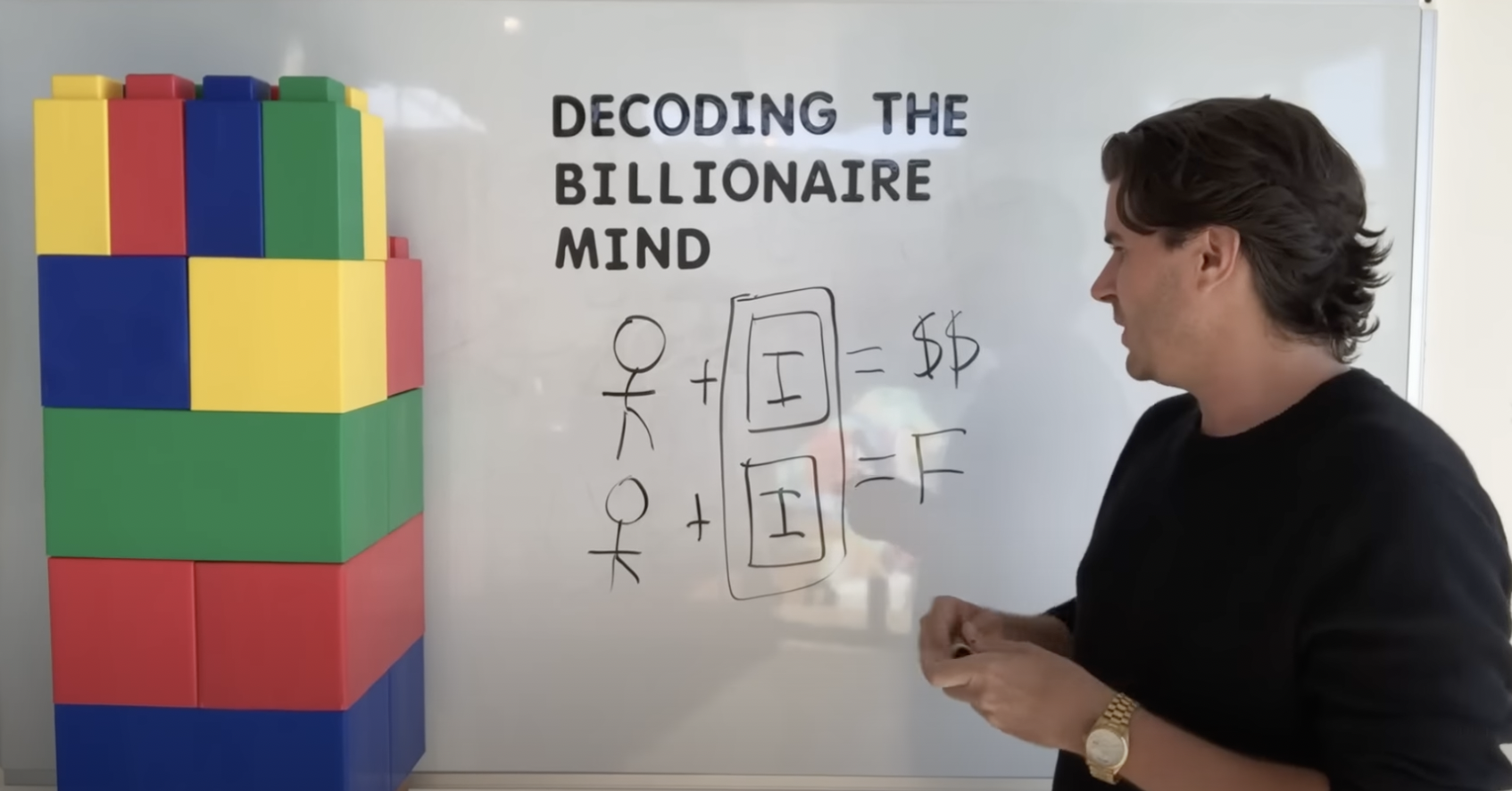
Here is Sam Ovens talking about this.
In the image, you see that two different people, come in contact with the same information (books, university, courses, mentorship, advice) but have very different results (money vs failure).
The point here is that, it is not about the information, it is about the human’s mind. We fail when we just fixate on the information variable, without considering the human variable of who that person is and how they think.
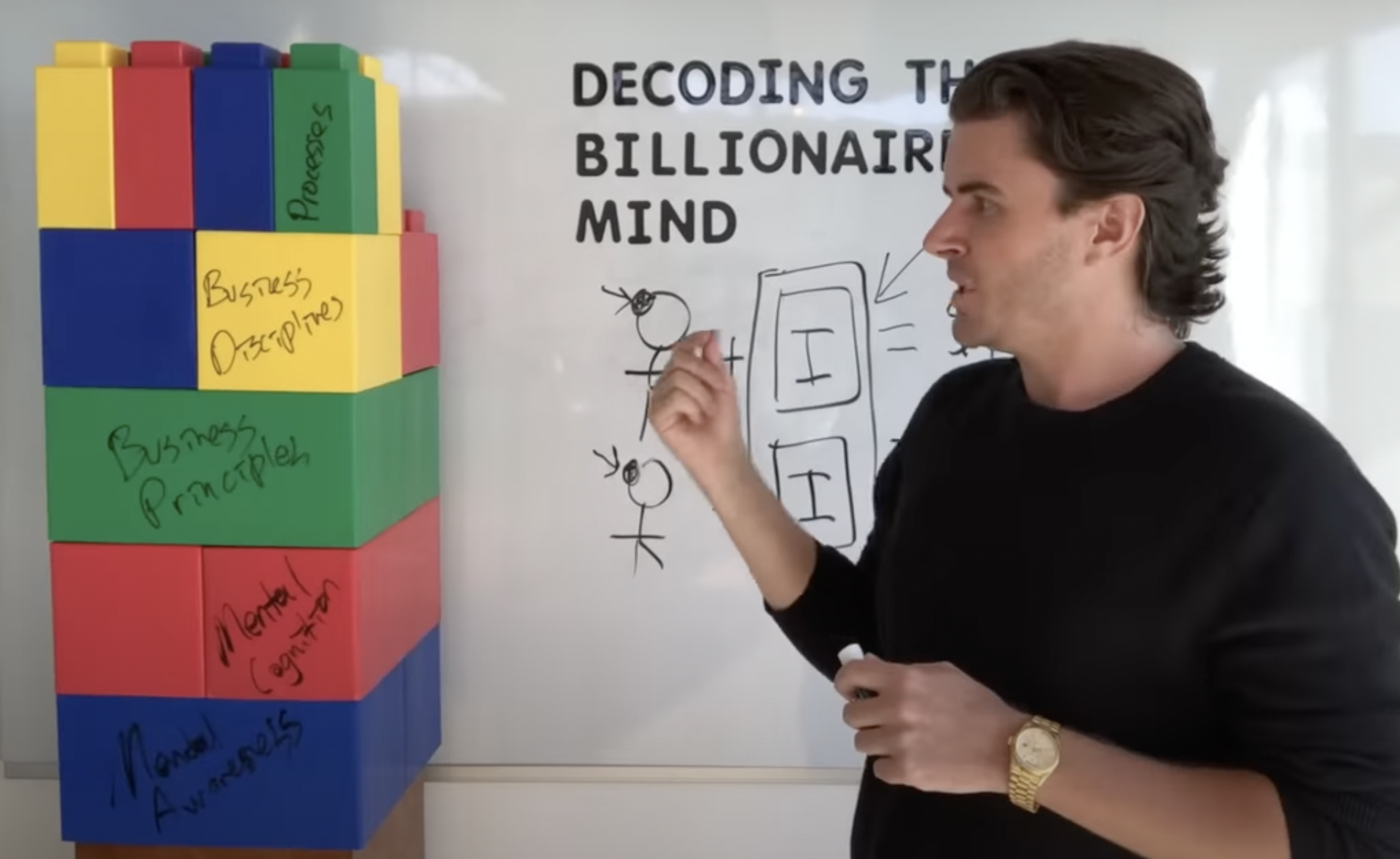
In this image, Sam has building blocks. These building blocks explain why we can go to university and still be an idiot after we graduate.
University only focuses on the information - even worse, information in a narrowly defined field (e.g. the specific process of how to categorise accounting transactions).
80% of our success is a result of who we are as a person. 20% is because of the information.
Therefore, university’s approach is literally the opposite of the 80/20 rule. When the the key building blocks of self-awareness level and mental cognition are missing, the information is useless.
This is something that has taken me too long to realise.
For far too long, I have relied on quick hacks and finding ‘secret’ information to solve my problems… without realising that the problem is me.
I am the reason why I am not where I want to be yet.
The information is there. It is the same information that others have used to achieve the things I want to achieve.
I don’t need more information. I need to become a better version of myself.
What a beautiful sport.
