Winners and Losers Have The Same Goals… So What Separates Them?
In life, there are clear winners and clear losers. Winners and losers both have the same goals, so what separates them?
This question has been on my mind for a long time now. My exploration to find an answer led me to study what winners do, that losers don’t. What habits do they have? What do they eat? What do their morning and evening routines look like? Do they use affirmations and visualisations? Do they believe in the law of attraction? What about semen retention?
The data I collected was conflicting, scattered and in no way neat. I could not find a clear pattern.
I found that some multi-millionaires woke up at 4am, others woke up at 10am. Some had a Keto diet, others loved their carbs. Some meditated, some didn’t. Some believed in the law of attraction, others laughed at it. Some were on semen retention for months, others were (self-proclaimed) sex addicts.
The one commonality amongst winners…
However, I did find one commonality. Winners were willing to pay the price that winning demands.
Let's use the shopping mall as an example. There is a really cool shirt for $1,000. You love it, but you don’t buy it. Why not? Because you are not willing to pay the price.
Similarly, everything in life has a price. Becoming rich. Creating a loving relationship. Getting a 6 pack.
These are things that everyone wants. However, just because you want to have it, doesn’t mean you are willing to pay the price and make the sacrifices necessary to get it - you want it for free, you don’t want to trade.
The more I speak to people who I consider to be winners about this topic, the more this belief gets reaffirmed.
One of the simplest explanations I’ve heard about this is: winners are “simply willing to sit in a chair for longer than others” and “sacrifice parts of their lives and be completely okay with it”.
The willingness to pay the price…
The cost of achievement for winners is sometimes family or most of the time friends and/or romantic relationships. For some, the cost is their health, perhaps both mental and physical. More constructively, sometimes the cost is the person who they once were - winners create a whole new identity, leaving their old self behind.
Whatever the case, there is always a price. And the reason why most are not winners is because of the choices they are willing to make and the price they are willing to pay.
Winners and losers have the same goals. Therefore, the goal doesn’t make you unique. It's the willingness to pay the price, upfront and in full that makes you unique.
This was a great realisation because it shifted my focus from the clickbait “millionaire morning routines” and “productively hacks to 10x output”, and put it on doing the actual work and giving whatever is required to get the job done.
But I soon came to another roadblock. There are many people who do pay the price and make sacrifices, but they still end up losing. Take an olympic sprinter for instance. I’m sure winning is all they think about and they are willing to pay whatever price is needed to win. So what separates the sprinter who wins gold from the one who finishes last?
This again led me down the route of exploring their habits, mindset, diet, morning routines etc. Yet again I found conflicting results. But I also found another commonality…
I had always heard cringe quotes like the winners “go the extra mile” and “outwork others” but I never found this advice practical.
Advertising showed me what separates winners from losers…
But, as I learnt more about advertising and the relationship between CPM, CTR and Conversion Rate (CR), I had an ‘AHA’ moment. Let's set the definitions and see how I got to my realisation (if you don't understand advertising, my brief explanation may not be enough for you to fully understand it.)
CPM is the cost per 1000 impressions
CTR is the percentage of people that click on your ad
Conversion rate is the percentage of people that buy your product (CR)
Let's analyse two scenarios:
CPM = $20 & CTR = 1% & CR = 1%
CPM = $20 & CTR = 2% & CR = 2%
Now the difference between the two scenarios are marginal. CPM is the same and CTR and CR are only 1% better in scenario 2.
Let's say you spend $1,000 on ads and your product is $100. Since CPM is the same, each scenario will buy 50,000 impressions.
Scenario 1 results in 5 people buying your $100 product (50,000 * 0.01 * 0.01), which equals $500. You spend $1,000, make $500 total and lose $500.
Scenario 2 results in 20 people buying your product (50,000 * 0.02 * 0.02), which equals $2,000. You spend $1,000, make $2,000 total and earn $1,000 profit.
The 1% difference in both CTR and CR is what differentiates a negative 50% loss from a positive 100% profit.
Very small marginal advantage = very large outcome difference.
Let's analyse another two scenarios:
CPM = $20 & CTR = 2% & CR = 2%
CPM = $10 & CTR = 4% & CR = 4%
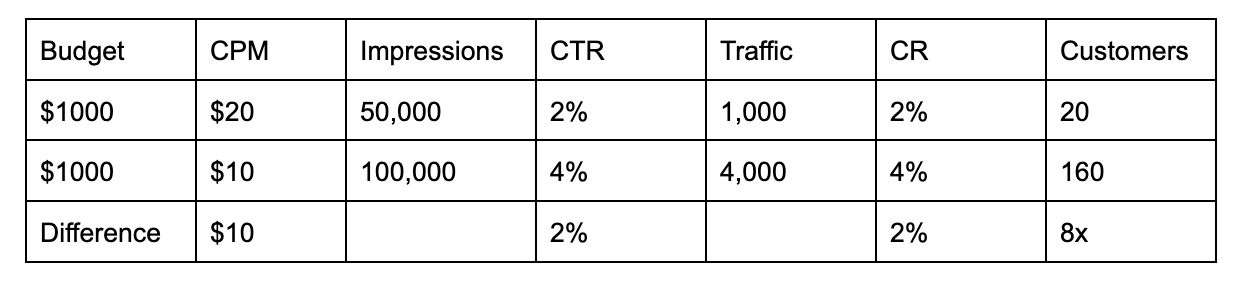
In isolation, a $10 lower CPM, 2% better CTR and 2% higher CR are pleasing, but nothing drastic. In combination however, scenario 1 leads to 20 customers, which equals $2,000 and scenario 2 leads to 160 customers, which equals $16,000 - an 8x difference. This is because these metrics dance with each other and compound to create vast differences.
In simpler terms: the marginal advantages in these metrics are what separates the winners and losers in the advertising space. They gain these marginal advantages because their offer, creative, copy, branding or messaging is slightly better than the competition (even though their product may be similar). These marginal advantages are not isolated. In fact, they dance and compound both with each other and over time to separate the advertisers who print money, from those that burn it.
I now realise that the same is true in life.
The model I have come to believe…
This is the model I have now come to believe:
Winners and losers have the same goals. What differentiates them is their willingness to pay the price upfront and in full - “they are willing to sit in a chair for longer”. The extra sacrifice that they make generates greater input which gives them a marginal advantage, that accrues in different areas and metrics. These small advantages compound with each other and with time to create vast differences in outcome.
If I were to describe it in one sentence, I would say: the winner’s willingness to make the necessary sacrifices and the consistent marginal compounding of their minor percentile advantage is the differentiating factor.
The statement above is very true in sports. Marginal advantages are the differentiating factor. This holds consistent in business - the greatest sport of them all.
The more advantages you can have in as many different areas and metrics, the more bigger the separation between you and your competition over time.
Whoops, I already knew this, but I didn’t understand it…
This is not a ground-breaking theory. However this is first time it all clicked for me. I have known about compounding for a long time now. And I’m sure I’ve read this ‘new’ realisation of mine in many books previously.
In Atomic Habits, James Clear’s said focus on 1% improvement everyday and by the end of the year you will be 37x better. I read this and thought “wow! great!” and never did anything with it because although I could read the words, I didn’t understand the concept. When I spent more and more money on Ads, and actually experienced how valuable 1% changes are, I finally understood this concept.
Even if someone tells you the answer, you may still be too stupid to understand…
This example showcases the fact that even if someone tells me the right answers, I may not yet be ready to hear it. In a politically correct way of saying it, I might not have had enough reference points and experience for the correct answer to make sense to me yet. In a ‘here is what reality is’ way of saying it, sometimes I am too stupid to open my mouth even when a silver spoon is trying to feed me.
This also displays that if someone is more successful than me in an area I want to improve in, and I get advice from them on what to do in that area, even if the advice doesn’t make sense to me yet, I just need to take it and execute.
I am not smarter than that person in that area, meaning if I ‘think’ about it and use my own incomplete data sample (ideas) to make a decision, I will most likely get it wrong - the decision therefore should not be “do I take the advice or not”, but “who is the best person to give me advice” about this area.
I found this to be true when I was preparing for my Muay Thai fight. At first, my coach's advice didn’t make sense to me. In fact, it felt wrong when I tried to implement it. It wasn’t until I completely surrendered, trusted my coach and executed with 100% conviction that I saw improvement.
Note: This blog is messy.
Mainly because although I have had realisations about why some people win and some don’t I am still not 100% sure. I rewrote this draft 4 different times before publishing it for myself, because I kept contradicting myself (I think I still contradict myself). One major flaw in this blog is the fact that it focuses a lot on gaining a marginal advantage through hard work and additional sacrifice. There are people who work less and still win.
I still believe that to win, a marginal advantage is needed (obviously). However, people can get that advantage can be earned in many different ways such as: intelligence, volume, efficiency, access to better resources, greater leverage, better information, people and many more. I still don’t know a neat way to tie all of this in but I wanted to write the blog anyway because I have realised two key points:
Winners pay the full price
Winners use compounding to separate themselves
In my later blogs, once I have more clarity, I will add more on what separates winners and losers.
Although not perfect, progress has been made in my understanding.
