Happiness Doesn’t Exist…
I don’t believe in happiness…
I don’t believe in happiness. It is very vague. It is like saying something is good - there is a wide range for interpretation.
In my last blog, I said:
Personally, I need days where I am completely alone - this is how I think best, become the most productive and am most at peace.
I hesitate to say that the days I am completely alone are the days when I am happiest, because that is not true.
I think there is joy, peace and fulfilment - I don’t think there is happiness. Looking back, I can’t think of a time where I have been happy.
No. This doesn’t mean that I have always been depressed…
I just think the definition of happy is too vague to pinpoint when I have felt it. I can remember many times where I have felt joy. I can remember even more times where I have felt peace. And I can definitely remember times where I have felt fulfilled. But happy? What does that even mean?…
According to google’s definition, happy means: “feeling or showing pleasure or contentment”.
Pleasure or contentment? That could mean a lot of things…
Pleasure: “a feeling of *happy* satisfaction and enjoyment” - Google.
So happy means pleasure and pleasure means happy?
Let’s try enjoyment.
Enjoyment: “the state or process of taking *pleasure* in something” - Google.
Pleasure?…
Okay, so happy means pleasure | but pleasure means happy or enjoyment | and enjoyment means pleasure.
Let's try the second path… Contentment: “a state of happiness and satisfaction” - Google.
Thanks google, I now know that happy means happiness!
Let’s do a quick recap…
Saying you feel happy is like saying you feel good. What does that even mean?
Saying you feel joy, peace or fulfilment - okay, now I know what you’re talking about.
Joy: “a feeling of great pleasure” - Google.
Peace: “freedom from disturbance; tranquillity” - Google.
Fulfilment: “the achievement of something desired, promised, or predicted” - Google.
This is why I don’t think happiness exists…
This is why I don’t think happiness exists - because we confuse happiness for joy, peace and fulfilment.
I get peace when I am alone.
I get joy when I am around others and doing fun things.
I get fulfilment from both situations (achieving my personal goal and fulfilled by the great relationships in my life).
These factors are mostly contradictory - you cannot maximise all three at the same time.
For example, if you want fulfilment, you need desire and desire creates suffering - (because your desire sets a contract stating that you cannot be ‘happy’ until you get what you want, and therefore disturbs tranquillity (peace)… and obviously if you are suffering, you cannot have joy).
In my life currently, I am optimising for peace and fulfilment.
Peace from having an inner sense of calm. Which for me comes from defined periods of solitude (no I am not sitting alone in a cave meditating - I just mute all notifications, deleting all socials and minimise my contact with people for a while).
Fulfilment from overcoming struggle to achieve a goal that is meaningful under my own definitions and rules + great relationships (quality over quantity).
And in fact, what I’ve found is that by optimising for these, I am actually more joyful when I am with others. This may seem contradictory to what I said before about the three metrics for happiness conflicting, but it’s not. Optimising for one metric leads to an increase in another down the line, but you cannot maximise all three simultaneously.
However, I still need a balance of all three. If I don’t have peace or fulfilment, I cannot be joyful and if I don't get a good mixture of joy into my life, it is difficult to be peaceful and fulfilled.
The emotional triangle of “happiness”…
This is the emotional triangle of “happiness” that I need to optimise for.
If you want more happiness, that’s great, but you can’t get more happiness - mainly because your definition is too vague. You can get more joy, peace or fulfilment however. And the balance and mixture which is needed to maximise overall ‘happiness’ is different for different people.
Everyone has their own equations they need to solve and their own models they need to build to maximise ‘happiness’ for themselves.
Impatiently wanting to get, what you don’t know you want…
A software engineer who specialises in AI and machine learning recently told me about this meme. It is about people impatiently wanting to get, what you don't know you want.
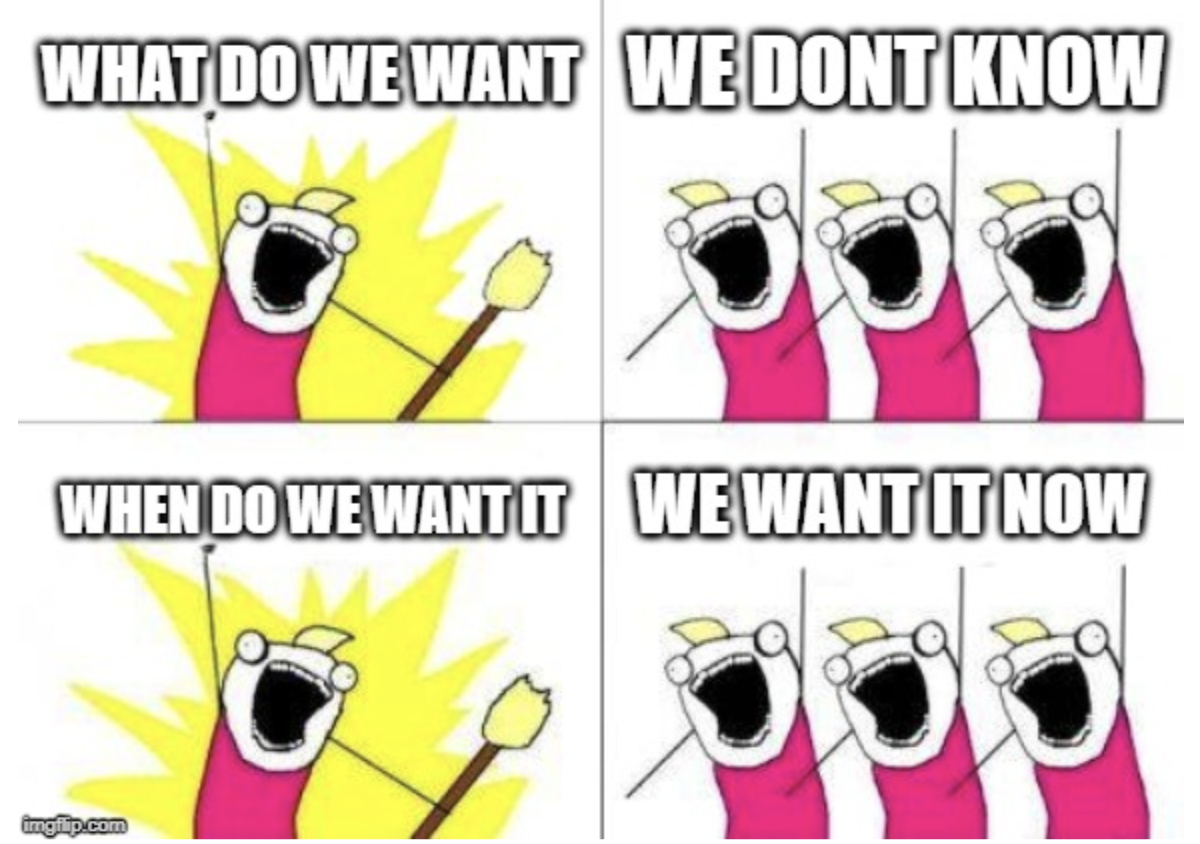
When I say I want to be happy, I am being this meme.
Every time I have “tried” to be happier, I have gotten more depressed. What a paradox. Now, I realise that is because I have been acting like that meme.
I tried to engineer for happiness, without knowing what happiness was.
“What do we want? > We don't know!”
Then, because I was focusing on happiness and working to be happy, I created the expectation that I should be happy.
“When do we want it? > Now!”
Contrast and expectations…
The contrast between expectations and reality is what creates suffering or pleasure so by working to be happy, I raised and set my expectation that I SHOULD be happy, but because I didn't know what happiness meant or was, I was working under a vague definition, doing vague actions and taking a generalised approach to a solving a specific issue.
Therefore, now, I never try to be “happy” anymore. I either try to be more peaceful (be okay with everything as is), more joyful (spending time with others, enjoying life, being grateful) or fulfilled (suffering to work towards a goal that I have labelled as meaningful).
The good thing is, I can do all these within a 24hr period.
Meditate in the morning (peace) > Work (fulfilled) > Dinner with friends (joy)
I know the costs involved in each of these pursuits and I know the opportunity cost of each. It is my choice to choose which metric I want most, and at which points, for how long. I also know that one often leads to the other.
Thank you…
(Thank you for listening to a 19yr old talk about how to be happy. Through my VAST age and experience (and not to mention WISDOM), I have definitely & completely figured out the magical key to blissful and eternal happiness - you’re welcome, thank me in bitcoin.)
P.S. - happiness is a loaded word and means a lot of different things to different people (which is the premise of this blog - it is vague).
Obviously happiness does exist.
Also, using the google definitions to make my point may also be a stretch and at times illogical. But these blogs are a fun hobby of mine, simply to document the progression my beliefs and how I think, over time.
I’m sure better examples and justifications exist, but, honestly someone (D) is waiting outside to get lunch but I want to post before I go.
Happiness does exist. Obviously. But because it’s so vague, it almost doesn’t exist - like smoke vanishing in the air when a gust of wind blows.
You say happiness. And I nod my head in agreement. But happiness for you, is completely different than it is for me. Meaning I am agreeing with my version of happiness and you are talking about your own.
There is a disconnect.
And by using words like joy, peace and fulfilment, communication is clearer (not only between you and others, but between you and yourself).
I think definitions matter. Because they set the parameters for our thinking and expectations. That’s why I don’t like to focus on “happiness” anymore. Every time I have “worked” on my “happiness”, I have gotten more depressed - mainly because of that meme example I gave:
What do we want? > I don't know!
When do we want it? > Now!
When I changed my definitions and used more precise terms like joy, peace and fulfilment and accepted the fact that they cannot all be maximised simultaneously, I became “happier”.
Clarity is powerful.
